Trip Itinerary
Itineraries are guidelines; variations in itinerary may occur to account for weather, road conditions, closures, etc. and to maximize your experience.
Wed., Aug. 4 Welcome to New Brunswick | Arrive in Moncton (YQM)
Our tour begins today in Moncton, New Brunswick’s largest city of just over 200,000 inhabitants in the metro area. The city is inland in the Petitcodiac River Valley in the southeastern part of New Brunswick, about thirty miles from the Bay of Fundy. The city was once known for a wooden shipbuilding industry and later as a regional hub as a railway center. The river makes a major bend here and there is a large greenspace park to walk, and if some of our group arrives early, you’ll have time to see Moncton’s Capitol Theatre, which dates to the 1920s but is still very active today. The Aberdeen Cultural Center showcases Acadian culture with art and interpretive exhibits. There are a number of museums and historic sites as well.
Join an optional birding outing if you arrive early—we had out at 3:00 PM, followed by a welcome dinner at a restaurant near our hotel.
Accommodations in Moncton (D)
Thurs., Aug. 5 Johnson Mills Shorebird Centre & Northumberland Strait
This morning we kick off our birding on the Dorchester Cape at the Johnson Mills Shorebird Centre, a critical feeding location for thousands of shorebirds along their southbound migration. It’s not uncommon to see upwards of 50,000 migrant Semipalmated Sandpiper here at the right time of year. We spend the majority of the morning here, scanning the mudflats as the shorebirds probe into the mud to feed, keeping a keen eye out for other species such as White-rumped Sandpiper and Semipalmated Plover. Adult shorebirds can be difficult to identify with worn plumage— it’s so great to have a guide and scopes to help you learn. This important wildlife reserve, managed by The Nature Conservancy of Canada, hosts a seasonal interpretive visitor center that’s open from mid-July to September with the peak of shorebird migration occurring in the first two weeks of August. There is a large observation deck where we can view without disturbing the flocks, there to fuel up for a long migration.
In the afternoon we head over to the Northumberland Strait, a very different coastline from the muddy, high-tide reaches of the upper Bay of Fundy. Here we look for beach-nesting species such as Piping Plover and Common Tern, along with any shorebirds and waterfowl working the shallower, warmer strait waters. This 140 mile-long strait separates New Brunswick from Prince Edward Island and is strongly influenced by tides. We are on its western end today.
Songbirds in the area may include Boreal Chickadee, Bobolink, Nelson’s Sparrow, and Nashville, Bay-breasted and Black-throated-Blue Warblers, to name a few. Black-billed Cuckoo and both Red and White-winged Crossbills are possible to see in the area as well.
We return to Moncton for a second night. Known as “Hub City” to Canadians, there are some great local restaurants to choose from.
Accommodations in Moncton (B,L,D)
Fri., Aug. 6 Birding from Moncton to Grand Manan | Hopewell Rocks | Black’s Harbor Ferry to the Island | Possible Puffins and Whales!
After breakfast, we head out towards the Bay of Fundy and its striking coast, birding along the way. A highlight of the day is stopping at Hopewell Rocks, a provincial park where the tide can expose or submerge over 40 feet of shoreline in a matter of hours. This is one the highest tides in the world, and waves have sculptured fantastic sea stacks 40-60 feet in height. Also called “flowerpot” rocks, these red-brown sandstones date back 300 million years, in places cemented together by sand and silt, conglomerate rocks record over 600 million years of earth history. Where we view from depends on tides, but have your cameras ready!
Watch for Peregrine Falcon or Merlin on patrol, Double-crested Cormorant sunning their wings, Hudsonian Whimbrel probing the shoreline, and Evening Grosbeak harvesting conifer seeds—Pine Grosbeak is also possible. This is a good area for finding warblers as well. Depending on timing, as typical of a good birding trip, we may check a local sewage lagoon or two along the route; these can be some of the most productive spots in the province for concentrations of shorebirds and waterfowl and a bonus of finding more species of warblers, families with fledged young, and early migrants on the wing, in the nearby trees.
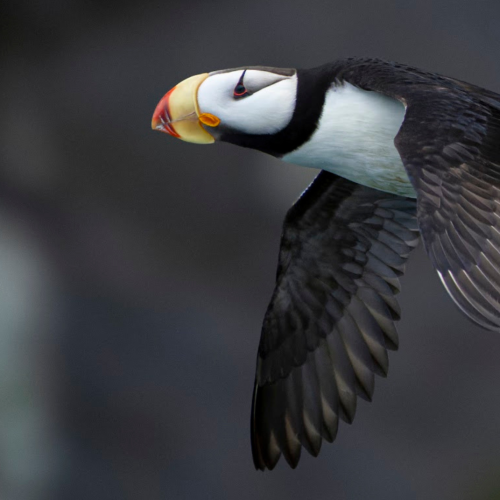
In the afternoon we continue on to Black’s Harbor to catch the ferry across to Grand Manan Island. The hour-long crossing can be quite exciting for both birds and marine mammals; we bird the duration of the journey, keeping a lookout for Great and Sooty Shearwaters. Alcids such as Common Murre, Razorbill, Atlantic Puffin, and Black Guillemot may be resting on the water, and we may also see Humpback and Minke Whales as we cross the channel. We settle into our accommodation on Grand Manan for the evening.
Accommodations on Grand Manan Island (B,L,D)
Sat., Aug. 7 Bay of Fundy Pelagic Trip
Today we head out into open water on a dedicated Bay of Fundy pelagic trip in search of true seabirds rarely seen from shore. We watch for Wilson’s and Leach’s Storm-Petrels, Great and Sooty Shearwaters, and if we are lucky, a Manx Shearwater. Pomarine and Parasitic Jaegers may harass gulls and terns over the water, and there is always an outside chance of a South Polar Skua this far offshore. We also keep an eye out for Humpback and Minke Whales, and other marine life that frequents these nutrient-rich Fundy waters. This part of the ocean experiences deep submarine upwellings and along with the region’s fabled tides has incredible productivity for seabirds, whales, and other marine mammals. Puffins are still here, and we are likely to see family groups with little pufflings! We should be out on the water 4-6 hours, so dress in warm layers, take your motion-sickness meds if you need them, and be ready for memorable sightings.
Accommodations on Grand Manan Island (B,L,D)
Sun., Aug. 8 Birding on Grand Manan (Pelagic Backup) | White Head Island
Today is held in reserve in case the pelagic trip could not run on yesterday due to weather or sea conditions, in which case we make our attempt today. Birding is great on the island itself, with the option for a side trip to White Head Island. Several points of the island attract land birds as well as shorebirds and are picturesque to visit, with rugged shorelines and lighthouses. Local saltmarsh areas can be quite productive.
White Head Island is reached by a short ferry from Ingalls Head, and offers us a quieter, less-birded slice of shoreline and open barrens that can turn up migrant songbirds and shorebirds not always found on the main island. Time exploring Grand Manan’s forest ecosystem is a nice contrast to the shoreline; we hope to see a great variety of early migrant and post-fledgling songbirds at eye level in the shrubbery as they refuel on the island, species such as Blue-headed Vireo, American Redstart, Black-and-white Warbler, Northern Parula, Bay-breasted Warbler, and Yellow-rumped Warbler often feature prominently here. Along the shoreline we look for shorebirds, Common Eider, three species of scoters, and Great Black-backed Gull towering over the more abundant Herring Gull.
Accommodations on Grand Manan Island (B,L,D)
Mon., Aug. 9 Morning on Grand Manan & Ferry to Saint John
We have one more morning to bird Grand Manan, searching for early migrants and some lingering breeding species. We also catch a wonderful local lunch, another chance to sample some of the island’s fresh seafood if you wish, before catching an afternoon ferry back to the mainland to Black’s Harbour. From here, we continue on to Saint John, less than an hour’s drive, where we spend our final night near the airport. Tonight we enjoy a final celebratory dinner, recounting our favorite memories of the trip and our final evening species list.
Accommodations near the St. John Airport (B,L,D)
Tues., Aug. 10 Departures
It’s good bye for now to new friends before departures at leisure today. Depending on the time of your flight, we can offer some morning birding at a park near the airport. (B)